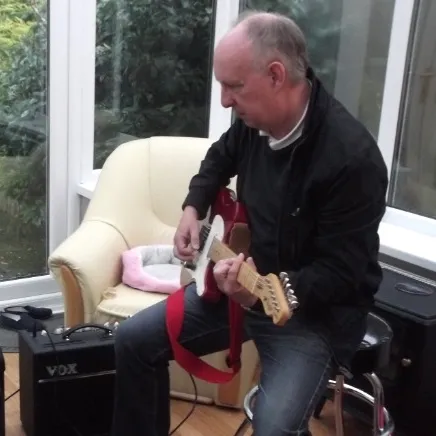


Your guide to learning guitar in Sunderland
Your music
Acoustic, electric or classical guitar
Choose the instrument that suits the sound you want to make. Acoustic guitar gives you chords and melodies without an amplifier; electric guitar lets you explore a wide range of tones; classical guitar offers a different feel and approach to the strings. I teach all three, so you can discuss your interests before choosing.
Songs give your skills a purpose
A favourite riff or chord progression can help us choose what to practise. Rock, blues, pop, metal, folk, funk and indie all offer different ways to hear rhythm and phrasing. We can reduce a difficult part to a few notes, then return it to the song as your confidence grows.
Getting started
What happens at your first lesson?
We talk about the music you enjoy and any experience you have, then find a comfortable starting point. Beginners can explore the layout of the guitar and a few simple chords. There is no pressure to arrive with a polished performance, so do not worry if you are starting from scratch. Bring questions and let me know beforehand if you need to borrow equipment.
Do I need my own guitar?
You can use spare equipment in lessons initially; please arrange this with me in advance. Before buying, think about a comfortable body size, how easily you can press the strings and whether the instrument stays in tune. An expensive guitar is not a substitute for one you can comfortably play.
Preparing your space
For a home lesson, choose a chair that lets you hold the guitar without twisting, leave enough space for us both, and have any music or questions nearby. If you already own an electric guitar, let me know about your amplifier and lead. Ask what to bring if you are visiting the studio.
Practice & progress
Make a short practice session useful
Start with one small aim: two chords that need a smoother change, a rhythm that loses its pulse, or a melody that needs clearer notes. Play slowly enough to hear what happens, repeat a manageable section, then try it in context. Regular short sessions are easier to build into a routine than an occasional long catch-up. It can be helpful to note where you get stuck and ask for feedback, keeping practice focused and enjoyable.
Connect tablature, music theory and listening
Tablature shows where to put your fingers; listening tells you how the phrase should move. Count a steady beat, notice where a chord changes, and sing or tap the rhythm before playing. Music reading and music theory can help explain patterns you already hear, without requiring you to learn everything before making music.
Returning players and intermediate guitar students
Bring a passage you enjoy and one that is giving you trouble. We can look at techniques for hand coordination, chord voicings, timing or phrasing and choose a next step. Tell me what you hope to achieve and which styles you prefer, so the work can match your interests. If grades interest you, discuss the syllabus and level with me; exams are optional, and learning for pleasure is a worthwhile goal.
Planning lessons
How much do guitar lessons cost?
Individual guitar lessons cost £12.50 for 30 minutes or £22 for an hour. Lessons are pay as you go, weekly, fortnightly or at another agreed frequency, subject to availability. Four half-hour lessons cost £50; four hour-long lessons cost £88. These are examples for four sessions, not fixed monthly subscriptions.
Choose a practical lesson length
A half-hour session can focus on a few clear tasks and often suits younger learners. An hour gives us more room to play, ask questions and revisit an exercise. Take into account concentration, travel arrangements and practice time, then discuss which lesson length will work for you. Music lessons should fit around school, work and the time you have to practise each week.
Where and how we meet
I travel to students’ homes in Sunderland and also teach at my home studio on Deepdene Road, Sunderland, SR6 8DR. Send your area or postcode so we can agree where to meet. Online lessons are also an option to discuss, alongside the main in-person offer. See prices and cancellation information before arranging a lesson.
Music around Sunderland
Listen with a guitarist’s ear
A live gig or performance video can become a useful listening exercise. Follow the pulse, notice when the guitar supports the singer, and listen for changes in texture between verse and chorus. Listen once to the guitar and again to the bass: notice how the parts support each other without playing identical rhythms. You do not need to copy a whole performance: choose one idea to ask about at your next lesson.
Explore the local music community
Use the local venue guide to find official programmes, read about musicians with Sunderland connections, or explore rehearsal and recording options when you are ready to play with others. Check arrangements directly with each provider before travelling or booking.